How to care for an Alocasia at home: light, watering, humidity and substrate
August 22, 2026
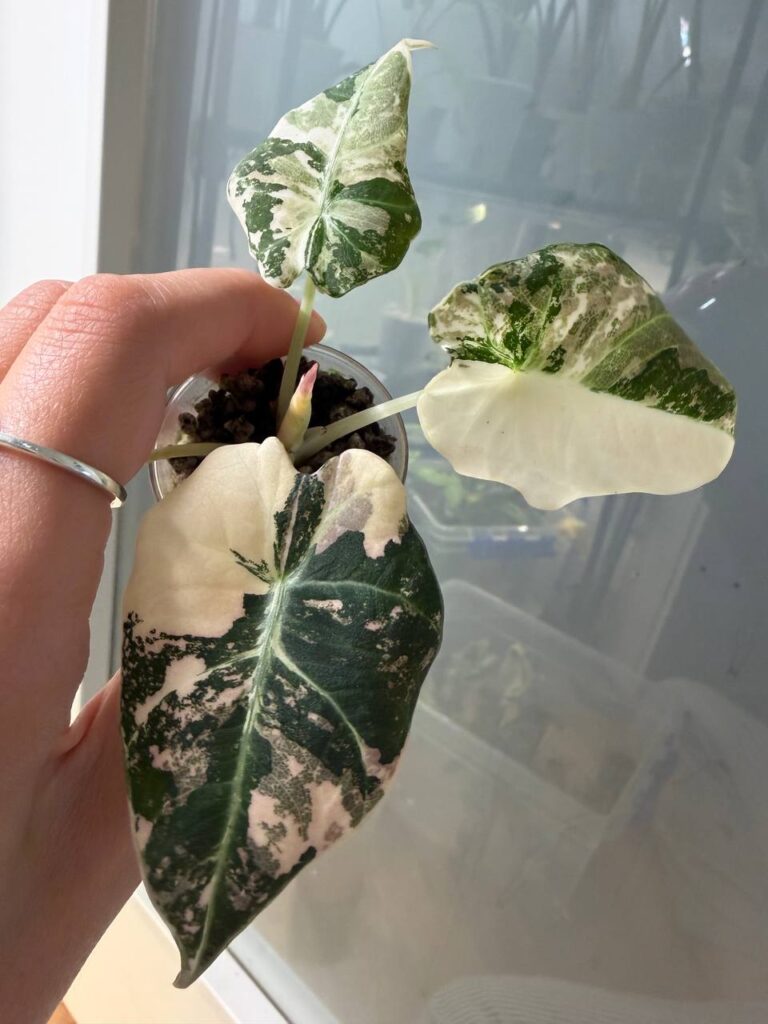
Alocasias have a reputation for being difficult, and it's not entirely fair. What they have is character: they want abundant but filtered light, high humidity and a substrate that never waterlogs. If you give them those three things, they grow fast and reward you with a new leaf every few weeks. Here's everything we apply at home with our rare Alocasias, explained without the fluff.
Light: plenty, but never direct sun
In the jungle, Alocasias live under the tree canopy: they get lots of brightness and little direct sun. At home, the ideal spot is a metre or two from a bright window, or right up against a north- or east-facing window. Direct midday sun burns the leaves (dry brown patches on the exposed area) and variegated varieties suffer even more, because the white or pink areas have no chlorophyll to protect them.
If the plant puts out increasingly small leaves or the stems stretch out reaching for the window, it lacks light. In winter, with short days, a simple grow lamp for 10-12 hours makes the difference.
Watering: damp, never soaked
The number one mistake with Alocasias is watering by the calendar. Water when the first two or three centimetres of substrate are dry to the touch; in summer it may be every 4-6 days and in winter every two weeks or more. Water thoroughly until water comes out of the drainage holes and empty the saucer: roots left in stagnant water rot, and an Alocasia with rotten roots collapses within a few days.
Yellow leaves and a soft stem at the base: almost always too much water. Drooping leaves, with dry edges and substrate pulling away from the pot: lack of water. If you can, use rainwater or filtered water; very hard water leaves the leaf edges brown over time.
Humidity and temperature
Alocasias appreciate an ambient humidity of 60% or more. Below 40%, new leaves can come out deformed or get stuck, and spider mites appear. Grouping plants, placing a humidifier nearby or growing them in a cabinet or grow cabinet are the solutions that work best; misting the leaves barely helps and wets the leaf for too long.
As for temperature, between 18 and 28 °C they're happy. Below 15 °C they stop growing and can go dormant; cold draughts and radiators right next to the plant are two silent enemies.
Substrate: airy and free-draining
A mix that works
Forget all-purpose soil as it comes: it compacts and holds too much water. A simple, proven mix is, in equal parts, quality substrate (or coco coir), coarse perlite and small pine bark. A handful of horticultural charcoal helps keep it healthy. The goal is for the water to pass through the pot in seconds and for the roots to have air.
A pot with holes, always, and of just the right size: an Alocasia in too big a pot takes a long time to dry the substrate. If you struggle to control the watering, well-used self-watering pots give constant humidity without waterlogging.
Feeding and winter rest
From spring to early autumn, a balanced liquid fertiliser at half the recommended dose every two or three waterings is enough. In winter, nothing: many Alocasias slow down or lose a leaf when the light drops. It's normal. If a plant loses all its leaves but the corm stays firm, don't throw it out: keep the substrate barely damp and it'll sprout again when the warmth returns. If you want to know more about that part, we have our guide on how to sprout Alocasia corms.
Pests: watch out for spider mites
Spider mites love Alocasias in dry environments. They're detected by fine yellowish stippling on the upper side of the leaf and, in advanced cases, webbing on the underside and in the axils. Check the underside of the leaves every week, clean with a damp cloth and, if it appears, treat with potassium soap and raise the humidity. Thrips and mealybugs are less frequent but are fought the same way: early detection and consistency.
Quick summary
- Abundant, indirect light; never midday sun.
- Water when the first few centimetres are dry and empty the saucer.
- Humidity of 60% or more; group plants or use a humidifier.
- Airy substrate (substrate + perlite + bark) and a pot with drainage.
- Gentle feeding in the growing season; rest in winter.
- Check the underside of the leaves: spider mites are stopped if you catch them early.
All the plants in the shop arrive already acclimatised to living in a home, so the change is much gentler than with a plant fresh out of a greenhouse. And if something doesn't add up with your Alocasia, write to us at info@marinasjunglegems.com: we'd rather have a timely question than a lost plant.
Text written with the help of artificial intelligence and published by the Marina’s Jungle Gems team.