Variegated Alocasias (albo, aurea, pink, mint): what they are and how to keep the variegation
August 22, 2026
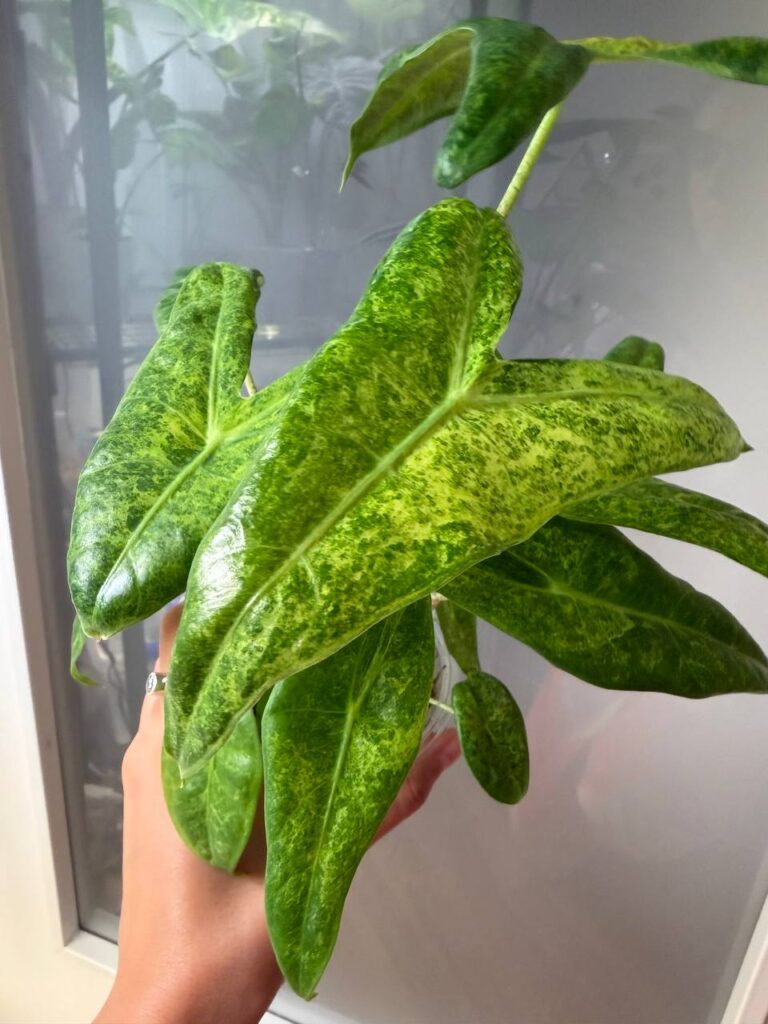
Albo, aurea, pink, mint, marble… If you've been looking at Alocasias for a while, you'll have seen these surnames after the names and their prices. They're all forms of variegation: areas of the leaf without chlorophyll (or with less) that show colours other than green. Here we explain what each one means, why these plants are so sought-after and, above all, how to care for them so the variegation isn't lost.
What variegation is
A leaf is green because of chlorophyll. When a genetic mutation makes some cells not produce it, those areas come out white, cream, yellow or pink, depending on the pigments they do keep. In Alocasias this mutation is usually unstable: each new leaf can come out with more or less colour, and the plant can “revert” to green or, at the opposite extreme, put out leaves almost without chlorophyll that don't survive. That instability is exactly what makes each specimen unique and unrepeatable, and that's why in the shop we always sell the exact plant in the photo.
The surnames, one by one
- Albo. White or cream variegation, in patches, sectors or half-leaves. It's the most contrasted and the most delicate in the face of sun.
- Aurea. Yellow or golden variegation. In practice it tends to behave a little more stably than the albo, without being a guarantee, and it looks spectacular on large leaves like those of the Alocasia Longiloba or the Wentii.
- Pink. Pinkish tones, from pale pink to fuchsia, sometimes mixed with white. Very sought-after in varieties like Black Velvet, Amazonica or Dragon Scale.
- Mint. Very light mint green, with a softer and more uniform look than the albo; it appears a lot in the Longiloba.
- Marble. A fine marbling, like marble, that spreads the colour over the whole leaf instead of in sectors.
One plant can combine several (for example, “Albo Pink” or “Mint Aurea”), and in many cases the name describes what the mother has shown so far, not a guarantee of what each future leaf will do.
Why they cost what they cost
The parts without chlorophyll don't photosynthesise, so a variegated Alocasia grows more slowly than its green version and needs more care. Besides, variegation can't be reproduced by seed: it's only passed on by division, by corms or by tissue culture, and even then it doesn't always come out the same. Few plants, slow growth and high demand: that's why they're collector's gems. Our plants and variegated corms come from our own collection and are grown at home, in small batches.
How to keep the variegation
Light: the key to everything
With little light, the plant “decides” it can't afford leaves with white areas and puts out increasingly green leaves. With too much direct sun, the chlorophyll-free areas burn. The sweet spot is plenty of indirect light: near a bright window without midday sun, or under a grow lamp. The variegated ones are, in fact, the reason many of us end up with a grow cabinet.
If it reverts to green
If several leaves in a row come out without colour, the first thing is to check the light. On a Monstera or Philodendron you can prune the stem back to a variegated node, but the Alocasia grows from a single point and doesn't allow that trick: cutting leaves is no use. What works is correcting the light and being patient; and if the plant forms corms, the offsets can come out variegated even if the mother has reverted. The opposite, almost entirely white leaves, is also a problem: they don't feed themselves and usually die soon. A healthy plant seeks balance.
The rest, like any Alocasia, but with more care
High humidity, watering only when the substrate dries on top, a very airy mix and constant watch for spider mites, which attack weakened plants sooner. You have the detail in our complete Alocasia care guide. Bear in mind that the white and pink areas are thinner and more sensitive: they mark easily from cold, knocks or very hard water.
Before buying a variegated one
- Ask to see the real plant, not a catalogue photo. Each specimen is different.
- Look at the last two or three leaves: they tell you where the plant is heading.
- Be wary of completely white or pink plants: they're beautiful and very fragile.
- Make sure it arrives acclimatised and well packaged: transport is the most critical moment.
In the shop you'll see in each listing the exact plant you'll receive, already acclimatised to living at home, and with our good-condition arrival guarantee. If you have doubts about which variety fits best with the light you have, write to us at info@marinasjunglegems.com.
Text written with the help of artificial intelligence and published by the Marina’s Jungle Gems team.